Smart Glasses UK: A Beginner's Compatibility Guide
Short answer: Smart glasses in the UK are wearable displays that mirror video from a compatible phone, laptop or console; they are not automatically standalone AI glasses. If this is your first pair, check that your exact device outputs DisplayPort video over USB-C—or budget for the correct adapter—before buying. The RayNeo Air 4 Pro is one example, but its 201-inch figure is a perceived virtual size at a specified viewing distance, not a physical screen.
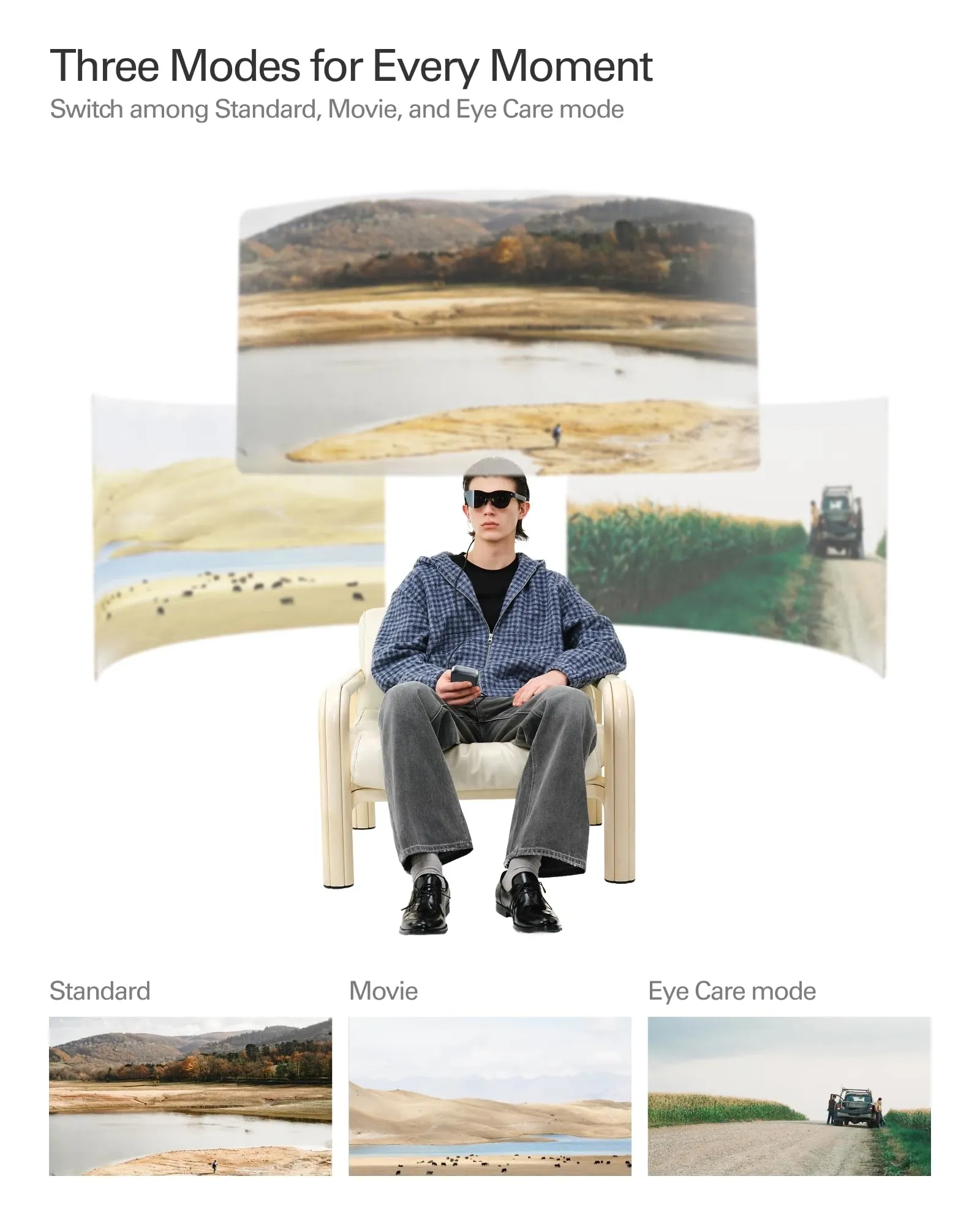
Fact check updated 20 July 2026. Manufacturer specifications and compatibility lists can change, so check your exact device before ordering.
What do smart glasses actually do?
In this guide, smart glasses UK means wearable display glasses: small screens and optics place a virtual image in front of your eyes while a connected device supplies the film, game or desktop. The RayNeo Air 4 Pro uses Micro-OLED displays and a USB-C video connection. It does not turn every phone into a spatial computer, and it should not be confused with camera glasses or a standalone mixed-reality headset.
That distinction matters for a cautious first-time buyer. The glasses cannot create a video signal that your phone does not provide. Your source device, cable, adapter, app and content all remain part of the setup.
Run this compatibility check before you pay
- Write down the exact device model. “Android phone” or “USB-C laptop” is not specific enough; different models in one range can expose different video features.
- Confirm DisplayPort Alt Mode. A USB-C port may support charging and files but no video. Check the maker's specification and RayNeo's current compatibility list.
- Identify the connection path. A compatible USB-C source can connect directly. Lightning iPhones, HDMI consoles and Nintendo Switch need the right powered adapter or accessory.
- Check the display mode you expect. HDR10 and 120Hz depend on the source, content and selected mode; buying an HDR10-capable display does not turn every video into native HDR.
- Plan sound and privacy. The B&O-tuned speakers are open near your ears. RayNeo's leakage-reduction features do not make audio inaudible to everyone nearby, so test volume or route sound through headphones when discretion matters.
- Allow for fit and vision. RayNeo lists a 76g product weight and adjustable fittings, but comfort is personal. Prescription lenses are a separate fitting and cost, not something the product price automatically covers.
If any answer is unclear, ask the device or glasses seller to confirm the exact model and required adapter in writing. That is safer than assuming a connector shape proves compatibility, and it reduces the risk of buying your first pair only to find that the phone cannot output video.
Which devices connect directly, and which need help?
iPhone
RayNeo documents direct USB-C setup for compatible iPhone 15-series and later models, but its compatibility list includes exceptions. For iPhone 14 and earlier, RayNeo specifies Apple's Lightning Digital AV Adapter plus a charged, powered HDMI-to-USB-C adapter. Check all parts before travel; “works with iPhone” is too broad to be a useful buying claim.
Android phones, tablets and laptops
Direct connection requires video-capable USB-C, normally described as DisplayPort Alt Mode or DP output. Many laptops and premium Android devices support it, while some phones with USB-C do not. Search the exact model's technical specification rather than relying on the port alone.
Steam Deck and other handhelds
RayNeo lists Steam Deck and Steam Deck OLED as compatible. Other handhelds still need model-level checking. The source device powers and drives the display, so battery use and charging arrangements depend on that device and any dock or adapter in the chain.
Nintendo Switch and HDMI consoles
RayNeo states that Nintendo Switch needs its JoyDock and that HDMI sources need a compatible HDMI-to-glasses adapter. Treat those as separate purchases unless the UK listing explicitly says they are in the box. A PlayStation's ordinary HDMI lead cannot plug straight into the glasses.
RayNeo Air 4 Pro: useful facts with the small print
| Published specification | What it means in practice |
|---|---|
| 201-inch virtual display | RayNeo specifies a perceived 201-inch image at a 6-metre viewing distance. It is not a physical 201-inch panel, and perceived scale varies with viewing conditions. |
| HDR10 and Vision 4000 | The display supports HDR10 and image processing, but source device, content and connection determine whether the intended HDR mode is available. |
| 60Hz default / 120Hz option | 120Hz can help compatible games feel smoother, but it must be supported and selected through the connected setup. |
| 76g manufacturer-listed weight | Light compared with many headsets, but not weightless. Nose fit, prescription inserts and session length affect comfort. |
| Audio co-tuned by Bang & Olufsen | Integrated speakers avoid a compulsory headset, but open audio is not the same as completely private audio. |
XROpt listed the RayNeo Air 4 Pro at £479.65 inc. VAT when this page was checked on 20 July 2026. That is a dated price observation, not a permanent promise; verify the current price, box contents and compatibility on the product page.
When smart glasses are not the right purchase
- You want a standalone device with its own apps, battery and computing. These glasses rely on a source device.
- Your phone has no video output and you do not want a powered adapter chain.
- You need sound that nobody nearby can hear. Open speakers reduce isolation compared with sealed headphones.
- You expect the same apparent image in every room. Ambient light, eyesight, fit and source quality change the experience.
- You are prone to eye fatigue or motion discomfort and cannot try a display first. Manufacturer eye-comfort features cannot guarantee symptom-free use; take breaks and stop if uncomfortable.
Being honest about these limits is especially important when the price is close to £500. A compatibility confirmation and a clear returns route are more useful than a long list of headline specifications.
A simple first setup
- Update the source device and choose downloaded, non-critical content for the first test.
- Connect directly only after confirming DP video support; otherwise assemble the approved powered adapter path.
- Start at modest brightness and volume, then adjust the nose pads and temples until the image is centred.
- Confirm 60Hz first. Enable 120Hz or HDR only when both source and content support them.
- Test for ten to fifteen minutes before a long journey or gaming session, and take regular visual breaks.
Frequently asked questions
Do smart glasses work with every USB-C phone?
No. A USB-C socket can carry charging and data without carrying video. Check that the exact phone model supports DisplayPort Alt Mode and appears on the manufacturer's compatibility list before buying.
Can I connect RayNeo Air 4 Pro glasses to an iPhone?
RayNeo documents direct USB-C setup for compatible iPhone 15-series and later models, but its list has model exceptions. For iPhone 14 and earlier, RayNeo specifies an Apple Lightning Digital AV Adapter plus a powered HDMI-to-USB-C adapter.
Do RayNeo Air 4 Pro glasses work with Steam Deck?
RayNeo lists Steam Deck and Steam Deck OLED as compatible handhelds. Use a suitable USB-C cable and confirm the handheld is sending video; the glasses act as an external display rather than running the game themselves.
Can I use them with Nintendo Switch or a PlayStation?
Not by assuming the included USB-C cable is enough. RayNeo says Nintendo Switch needs its JoyDock, while HDMI consoles need a compatible HDMI-to-glasses adapter; those accessories should be checked separately.
Is the 201-inch HDR10 picture guaranteed in every setup?
No. RayNeo defines 201 inches as a perceived virtual size at a 6-metre viewing distance, not a physical panel. HDR10 and 120Hz also depend on the source device, content, connection and selected display mode.
Check the current RayNeo Air 4 Pro listing
Price checked 20 July 2026; confirm device compatibility and the current offer before ordering.
View RayNeo Air 4 Pro — £479.65